


By Claire Schnatterbeck
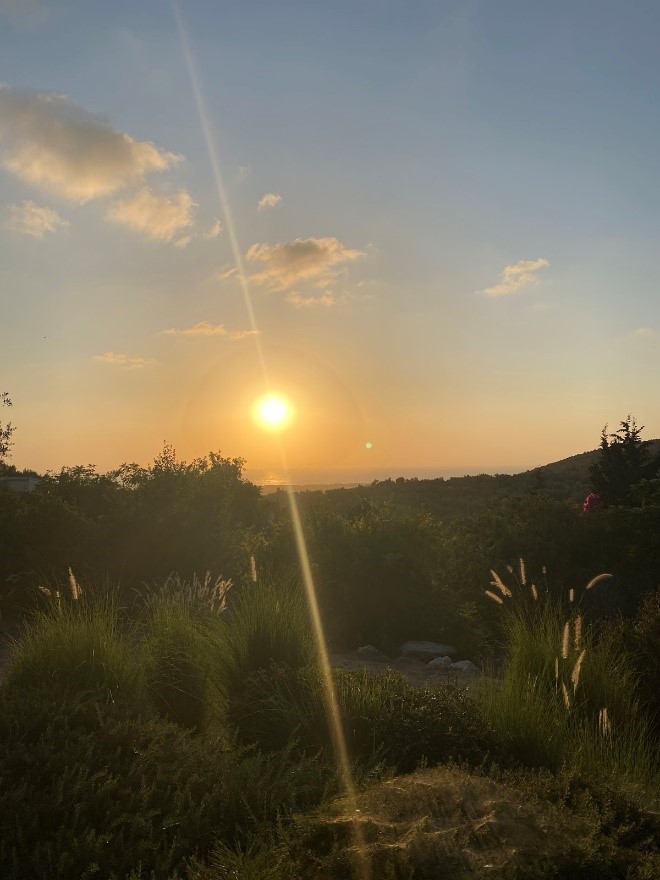
EIN HOD—While returning to Ramallah from Haifa, IFP students made a stop at the Ein Hod Artists Village. While the golden light of the setting sun made the village look like a beautiful oasis surrounded by olive trees and a stunning view of the Mediterranean Sea, closer research into the location's history brought a more insidious vibe to the pit stop.
Nestled at the foot of Mount Carmel, southeast of Haifa, the community settlement was formerly the Palestinian village of Ein Hawd. However, the Palestinian population was forcibly expelled during the 1948 Nakba, with many former residents resettling in the West Bank and the Jenin refugee camp.
Ein Hod became an artists' colony in 1953 and now serves as a space for Israeli artists and creatives. The village mosque was converted into a restaurant-bar and the old buildings were turned into homes for the artists. Sculptures and photographs from the artists are scattered all over the landscape.
This settlement is a stark example of how Israeli occupation has been “normalized” by liberal Israelis who may even see themselves as Palestine supporters. While “normalization” has many definitions, it is often used in situations where communities are engaging or cooperating with institutions linked to Israeli occupation. It could also be seen as contact with Israelis who do not recognize the occupation, and are not actively working for the freedom of Palestinians.
While not purely an ideological or religious settlement, Ein Hod bears the signs of how Israeli occupation has been aestheticized in the surroundings and the people. The romanticized, artsy vibe masks the true violence of the occupation under a guise of creative expression. In one art piece, tiles made to resemble the iconic Palestinian floor tiles were covered in writing and sketches. One of the tiles read “Arab is the new black.” What is the purpose of making art critiquing the occupation ON occupied land? What about the Palestinian artists who could gain creative inspiration from the gorgeous landscape?
When the IFP students visited, the colony felt almost deserted, with the only tangible signs of life being animals roaming around. It felt surreal to walk around—especially after visiting Haifa where Palestinians and Israelis supposedly “cohabitate”—a beautiful landscape and imagine the Palestinian village it used to be.