


By Claire Schnatterbeck
“I feel like there is a soldier in my bedroom. I feel like there is a soldier in my kitchen.”
– Said, Aida Camp Guide
AIDA CAMP, BETHLEHEM—Aida means “to return” or “an act of kindness” in Arabic. For that reason, it is the perfect name for the Aida refugee camp, located north of the historic center of Bethlehem. It was named after a woman, Aida, who was kind to refugees, but also the hope that all refugees share, that they’ll return to their homes taken by the Israeli occupation.
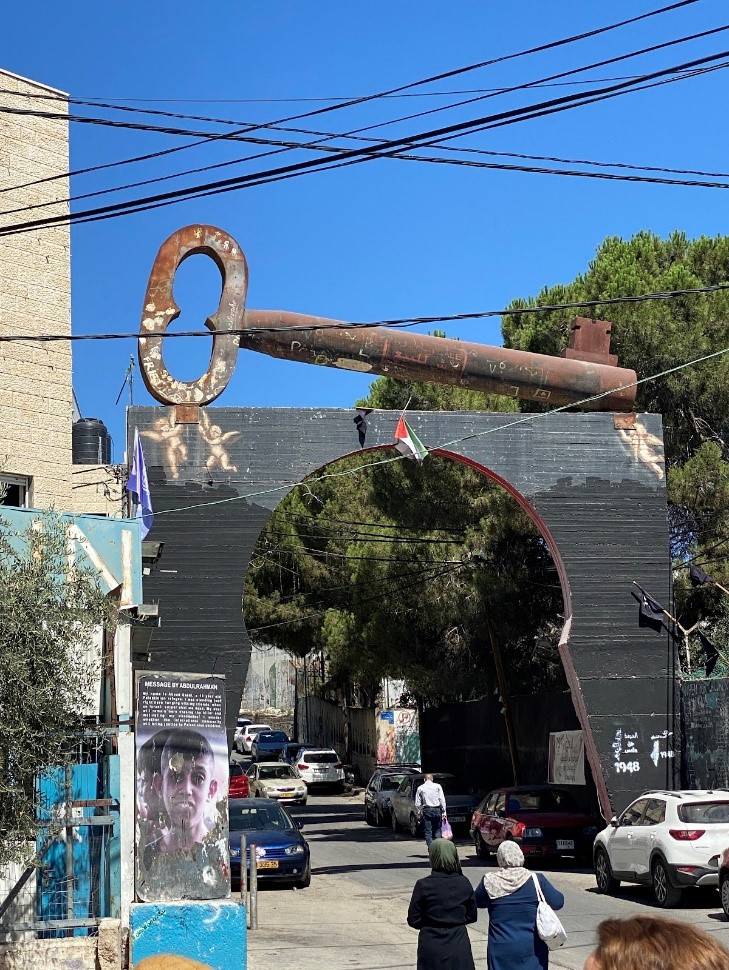
As the IFP-Palestine students entered Aida Camp, it was hard to miss the giant statue of a key at the entrance. The key symbolizes the keys to Palestinian homes occupied during the Nakba. Many Palestinians still have the keys to their homes to symbolize how they will return one day.
Camp History:
Established in 1950, Aida is one of the smallest camps created by the United Nations Relief and Works Agency for Palestine Refugees—also known as UNRWA. UNRWA takes many actions to assist and protect “registered” Palestinian refugees, including enabling emergency food assistance and providing important resources to the 58 recognized Palestinian refugee camps.
At its advent, Aida was plagued by terrible health and living conditions. UNRWA did not—and still doesn’t—receive enough funding to adequately support refugees. The camp was supposed to be temporary, as UN Resolution 194 called for the right of return for refugees. However, when Israel refused and a durable solution to the Palestinian displacement seemed bleak, the refugee camp became increasingly permanent. Refugees had to integrate economically into the surrounding communities (Bethlehem) in order to support themselves outside of the meager aid from UNRWA.
So, the temporary housing became more concrete, in more ways than one. The house building process was very cooperative, as in Palestinian tradition. However, given the limited space and resources, the building mainly took the form of crowded neighborhoods with narrow streets and haphazardly built homes on top of one another. The bottom living space was built by the UN, but now some buildings have three more built up floors. The weak foundation is not meant to withstand the weight on top. Despite the safety risks, vertical building is only the viable solution to accommodate population growth in the camp. According to UNRWA, there are over 7,100 registered residents in the camp as of 2022, mostly refugees from Jerusalem and Hebron. However, that number may not accurately reflect the true population of refugees living there. Aida camp has an estimated population density of 77,464 per sq km. It only covers 0.71 sq kms.
Privacy is a luxury in the camp. During their visit, IFP students weaved their way through the camp's narrow allies to get the full picture of the cramped living situation and weak infrastructure.
United States and UNRWA:
Currently, two United States Republicans stand in the way of 75 million US dollars in food assistance funding for Palestinian refugees.
US Rep. Mike McCaul and Sen. Jim Risch, top republicans in Congress's foreign affairs committees, used their positions to block previously earmarked aid to UNRWA, citing concerns over whether the agency promotes antisemitism or provides aid to Palestinian militants.
UNRWA notes that the aid hold would cause severe shortfalls if not resolved by September, potentially leaving more than 1.2 million people without necessary food assistance.
The situation is exacerbated by a May announcement that the World Food Programme will suspend food assistance to over 200,000 Palestinians because of monetary resource shortages.
In order for the aid to be distributed before the September deadline, UNRWA must agree to more oversight and accountability measures by the US, including implementing policies to prevent the dissemination of content deemed antisemitism, violent, or anti-Israeli
The US was the largest donor to UNRWA in 2022, contributing 344 million dollars. In comparison, the US sends Israel around 3.3 billion dollars in military funding every year. A much larger sum than goes to support Palestinians in need.
The visit to Aida was one of the first times IFP students had actually seen the UN’s presence explicitly in Palestine. There were UN flags, workers in vests, and UN labeled buildings around the camp. The aid in Aida appears to mostly be medical. Said, the tour guide for the day noted that, “They give us money to bandage ourselves.”
A Tour of Terror:
Much of the visit was cut with instances and images of Israeli violence. The market near the camp has been replaced with a military training base and the main street running through the camp, once called “The Live Street,” is now referred to as “The Ghost Street.”
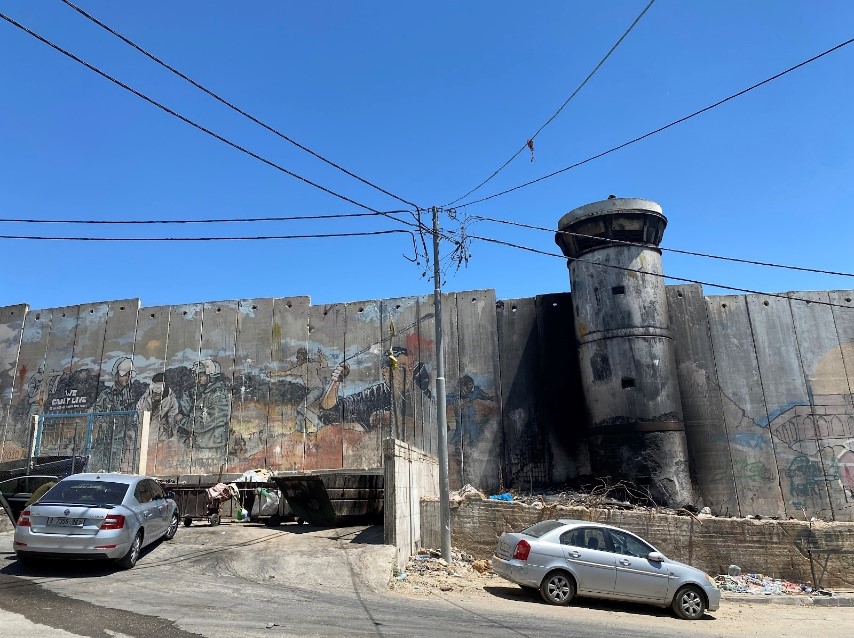
It was hard to ignore the tall, graffitied partition wall running along the edge of the camp. The wall has 7 watch towers, however, the tower directly across from the camp was burned six years ago due to Palestinian resistance. Despite this, the surroundings still bear the scars of Israeli surveillance and attacks.
The wall of a building opposite this tower is riddled with bullet marks. The tour guide emphasized to the IFP students that the identity of the refugee residents is greatly impacted by the occupation. The amount of surveillance—from cameras, to soldiers, to automated machine guns along the edge of camp, to the presence of the wall in general—causes an inescapable need to self-police, which the guide noted created a “subjectivity of self.” For residents, it is difficult to have a personal conception of identity outside of the narratives perpetuated by the occupation and Israeli forces: Palestinian resistance to IDF violence mislabeled as “terrorism,” people displaced from their homes by the Nakba and continued Israeli colonization referred to as “present absentees,” etc.
In addition, the guide noted that the continued occupation also creates a sense of “landscape amnesia,” or “creeping normality,” where Israeli colonization is slowly normalized through small, incremental instances of oppression and change that would otherwise be obviously objectionable if it took place in a single event. An example of this was the “knock on the wall” system that was used heavily in the camp. In this tactic, IDF soldiers would knock on the doors of refugee homes and then plant bombs that would go off as the refugee approached the door.
The guide recounted the feeling of mental torture perpetuated by this tactic. Small signs of responses and adaptation to the occupation are present all over Aida. Instead of metal water towers, they have plastic ones that are easier to patch up when IDF soldiers use them for target practice. According to UC Berkeley, Aida is one of the most tear gassed places in the world. In a shop in the camp, they sell jewelry made from the gas canisters, canisters labeled “Made in the USA.”
IFP students left the camp with a greater understanding of the daily lives of Palestinian refugees and the struggles they face, but also with an appreciation for how they resist an exclusive narrative of victimization and still live their lives and celebrate their community.