


By Maryam Shuaib
HEBRON, WEST BANK– Following the visit to the In Situ exhibition, IFP-Palestine students visited the Hirbawi Factory, which is currently the last standing factory that produces keffiyehs in all of Palestine. Founded by Yassar Hirbawi over sixty years ago, the Hirbawi factory is currently run by Yassar’s three sons and Izzat Hirbawi, a longtime friend of the family.
Given its family-oriented nature, the Hirbawi Factory confronts the challenges of the free market economy as a result of globalization. Competing cheap importations, primarily from China, make accessing the keffiyeh easier for worldwide consumers. However, the family owned factory struggles to maintain a growing supply of the popularized scarf. Despite this major obstruction, the Hirbawi family is committed to preserving the originality of the keffiyeh through native weaving practices.
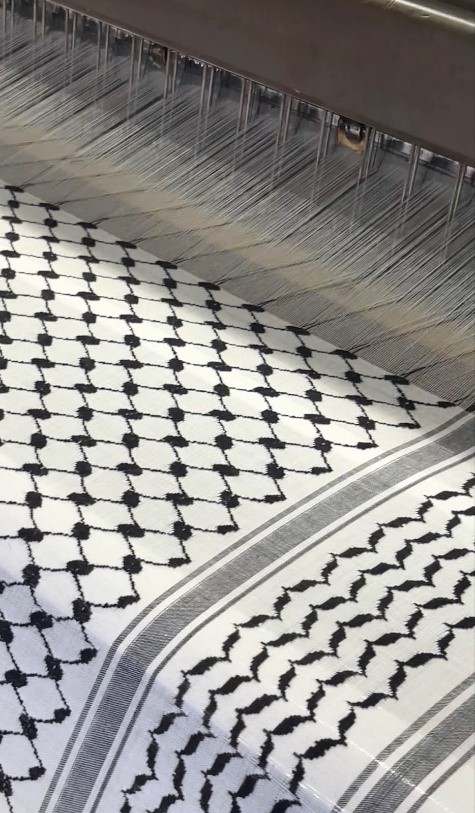
While touring the factory, students were able to see, first hand, the mechanized weaving techniques that are utilized to manufacture each individual keffiyeh. The industrial looms require constant monitoring to ensure that the process of production is seamless. All repairs are done by hand, which contributes to the meticulous training that accompanies the Hirbawi family’s goal of sustaining the family owned factory. The small-scale production of keffiyehs maintains the vessel of resistance that is emulated by the kuffiyeh’s pattern.
Often alluded to as the unofficial flag of Palestine, the keffiyeh comprises three patterns. The fishnet pattern dominates most of the fabric, as it represents the collectivism that accompanies Palestinian identity. The thick borders represent the entangling trade routes that provided economic advantages to Palestinians. The bird-like motif is reminiscent of olive leaves, thus visually representing the olive tree’s importance to Palestinian life, and identity by extension.
The existence of the Hirbawi factory is a quintessential symbol of resistance to the destructive nature of the occupation. Despite Hebron’s divisive dynamic, the factory continues to produce and ship the most authentic form of Palestinian identity while also challenging the convenience of globalization.