


By Claire Schnatterbeck and Maryam Shuaib
“It’s about showing how enriching this kind of life can be…spaces have a pedagogy of their own.” – Tareq Khalaf, Sakiya
EIN QINIYA, WEST BANK—On Friday, July 14th, students from the International Field Program-Palestine program visited Sakiya, an educational space that combines agrarian traditions with art and ecology. Throughout the visit, students were not only shown the incredible landscape and gardens, but asked to examine the importance of sharing traditional knowledge in Palestine. In a country with much of its history and knowledge destroyed or manipulated by the ongoing Israeli occupation, Sakiya seeks to emphasize experiential learning as a way to derive wisdom from what is tangible in nature, while also connecting to traditional roots.
While land usage is a powerful tool of Israeli control, it is also a form of Palestinian resistance. There is a common perception that land is considered wasted if one does not exploit it of all existent resources. An Ottoman Era law—currently enforced by Israel for the purpose of obtaining Palestinian land—states that any plot of land not cultivated for three years, or with less than half its area cultivated, must be returned to state ownership. The appropriation of much of the West Bank has resulted from Ottoman Era law and meticulously calculated legal standards, which has contributed to minimizing the sustenance of the land to Palestinians.
Sakiya, however, aspires to be in harmony with its environment, for example, utilizing natural springs and channels from hundreds of years ago to irrigate its crops. While the students were visiting, two different herds of sheep came to graze. Tareq Khalaf, who led the tour and works full-time at Sakiya, emphasized the importance of interconnectedness between every animal and human. He noted that, when restoring and renovating Sakiya, they keep in mind the sheep, bats, frogs, etc. who also utilize the land and contribute to its sustainability.
The existence of Sakiya, as an organization, is a form of Palestinian resistance that seeks to reinstate a system of ethics and culture through prioritizing the native Palestinian environmental landscape. Sakiya confronts the challenges that are presented with the popularization of an urbanized landscape, and the waste that results from it. The collective labor that contributes to the conservation of Ein Qiniya emulates the possibility of an alternative lifestyle that utilizes ecological strategies of resistance against illegal land dispossession.
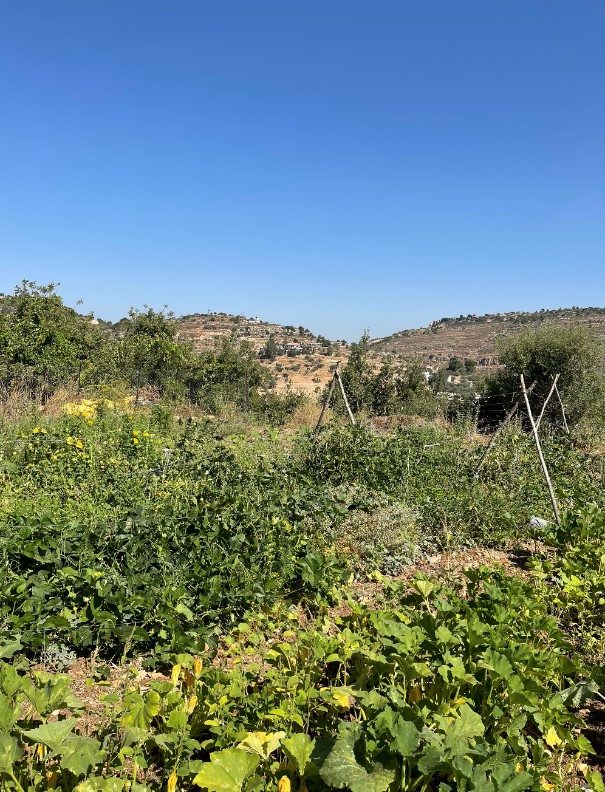
Collective labor and building community are also important parts of Sakiya’s mission. While visiting, IFP students worked together to pick vegetables from the garden, cook, and share a meal of shakshuka, humus, and bread. Khalaf noted how the organization tries to engage the community around Sakiya, artists in residence, and international visitors to share their knowledge and learn through educational programing and volunteer opportunities for all ages.
IFP students left Sakiya with full stomachs and a deeper understanding of work happening within Palestine to not only cultivate crops, but also cultural understanding and traditions.
IFP participate and New School GPIA Graduate student Christina Wong is completing an internship at Sakiya during the program.